Project Overview
The Training Client Protection (TCP) course was designed to educate the Amartha A-Team on the critical principles of safeguarding clients. The core challenge was humanizing compliance — instead of presenting client protection as a dry legal requirement, I structured the narrative around Trust and Growth, framing it not as a set of rules, but as a strategic "shield" that ensures fairness and secures the long-term sustainability of the business
The course reached 2,031 participants, with 1,475 completing both pre and post-test assessments and 1,028 achieving full course completion (including feedback and certification). Assessment data showed a meaningful learning gain — average scores improved from 54.04 (pre-test) to 79.12 (post-test), yielding an N-Gain of 44.64% (Medium Gain) across assessed participants.

1. Strategic Objectives
The primary goal was to ensure participants understand and actively apply Client Protection principles in their daily operations. The course aimed to:
- Shift Perspectives: Establish client protection as a long-term investment in client trust, rather than a mere administrative checklist.
- Highlight Mutual Value: Demonstrate the "win-win" benefits, focusing on financial empowerment for the client and sustained reputation for the company.
- Drive Implementation: Equip the team with the practical knowledge to implement the 8 Core Principles of Client Protection.
2. Instructional Design & Creative Execution
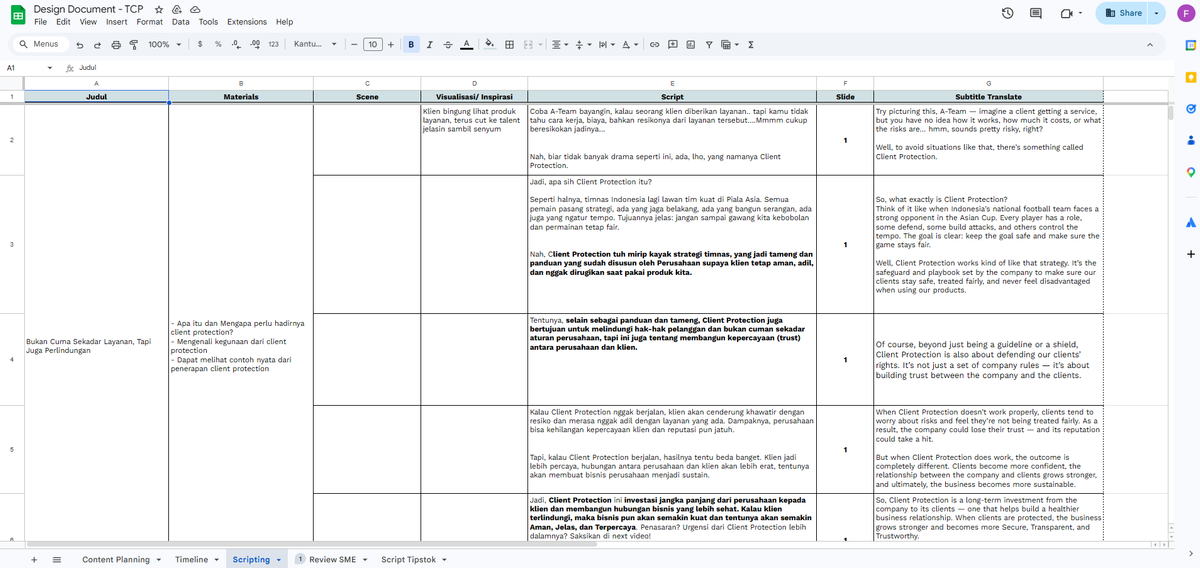
The instructional flow was designed to move progressively from Empathy (understanding the client's risk) → Logic (strategic business benefits) → Action (applying the principles).
- Relatable Storytelling: Transformed dense compliance guidelines into a conversational script featuring relatable characters to maintain a professional yet accessible tone.
- Analogy-Driven Learning: Used a "National Football Team" analogy to explain how client protection acts as the defense preventing the company from "conceding goals" (operational risks).
- Humor & Real-World Scenarios: Grounded abstract concepts using everyday examples (e.g., "cappuccino vs. iced tea" to explain product transparency).
- Blended Delivery Format: Combined video lectures for foundational knowledge with explainer/tutorial videos for principle-based learning.