Project Overview
The Amartha System Architecture course was designed to demystify complex engineering frameworks for internal tech teams. The core challenge was translating highly technical, abstract architectural concepts into clear, visual, and actionable instructional content. By breaking down the infrastructure, this project ensures that all engineering teams share a unified understanding of the systems that power Amartha, fostering better collaboration and technical alignment.
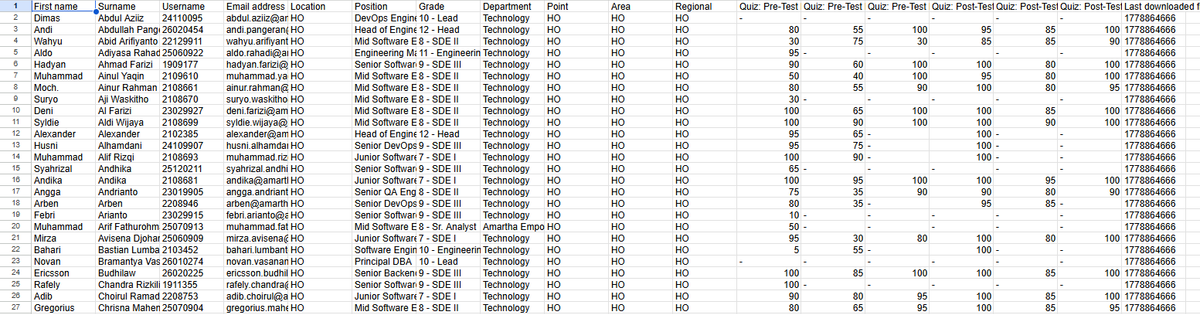
The course reached 123 participants, with 72 achieving full course completion. Assessment data showed a significant learning gain — average scores improved from 74.58% (pre-test) to 92.43% (post-test), yielding an average N-Gain of 54.83% (Medium Gain) across assessed participants.
1. Strategic Objectives
The training was developed to bridge the gap between high-level architectural design and day-to-day engineering execution. The primary goals were to:
- Ensure Technical Alignment: Standardize the understanding of Amartha's core architectural principles and tech stack across all engineering pods.
- Accelerate Onboarding: Provide new engineers with a clear, visual roadmap of the system infrastructure to significantly reduce time-to-productivity.
- Promote Best Practices: Empower developers to proactively build systems that are secure, scalable, and resilient by design, rather than as an afterthought.
2. Instructional Design & Content Strategy
To prevent cognitive overload when dealing with dense technical documentation, the instructional strategy relied heavily on visual storytelling and structured deconstruction:
- Visualizing the Abstract: Translated static, text-heavy API documentation and system schematics into dynamic visual learning assets to help learners easily map out data flows and system interactions.
- Framework Deconstruction: Broke down monolithic engineering concepts into digestible, modular learning paths to maintain learner engagement.
- Contextualizing Engineering: Rather than merely teaching theoretical concepts, the content grounded every topic in Amartha's specific operational challenges and real-world system implementations.
- Targeted Content Pillars: Structured the curriculum into key operational areas:
- Scalability & Performance: Exploring strategies for handling increased loads and optimizing system throughput to sustainably support continuous growth.
- Reliability & Resiliency: Focusing on fault tolerance, disaster recovery, and maintaining high availability during component failures.
- Security Architecture: Diving deep into safeguarding the financial ecosystem, covering data protection protocols and mitigating vulnerabilities across the infrastructure.